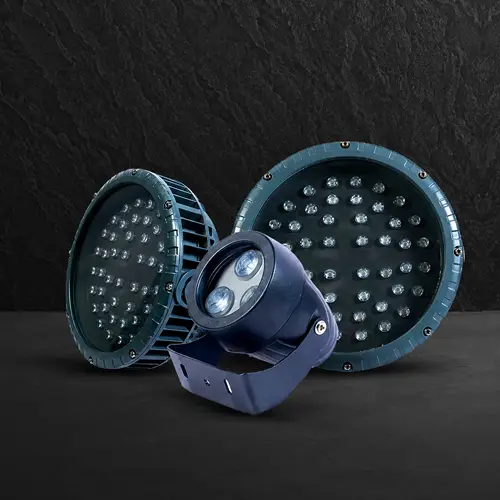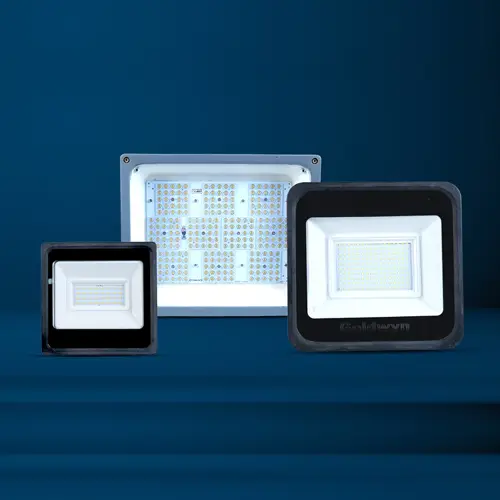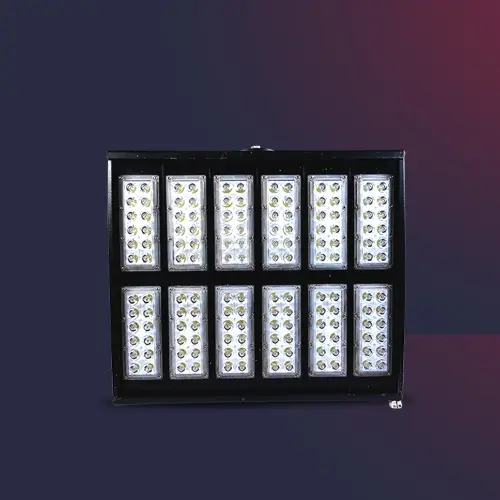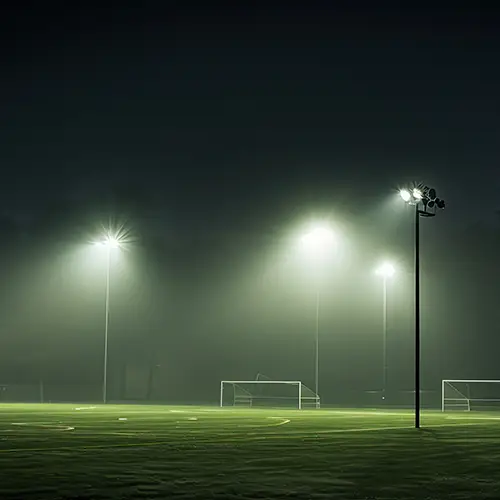
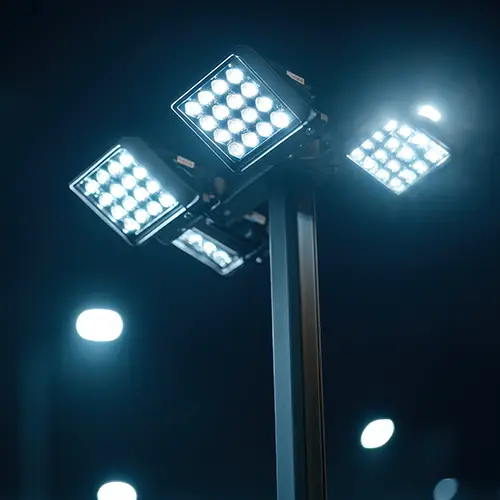
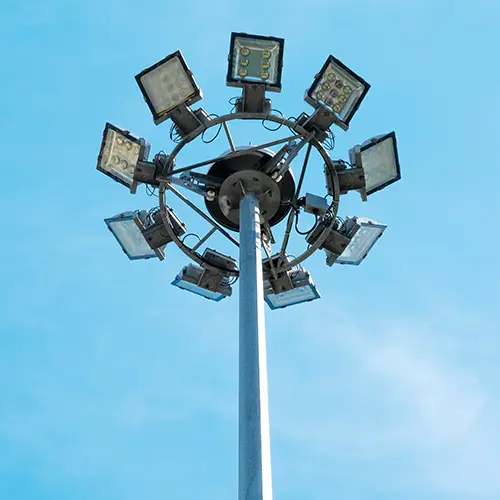
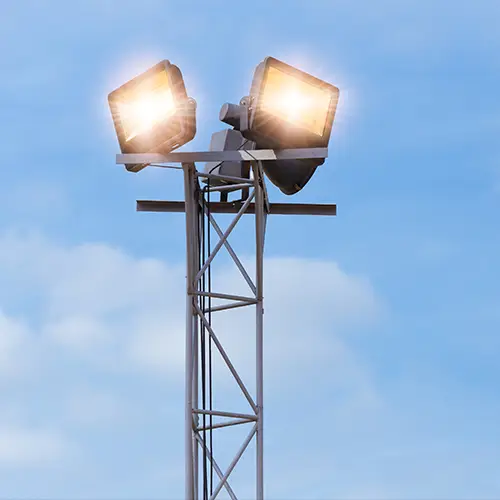
Flood Lights are high-output luminaires designed to distribute light across outdoor spaces, industrial premises, building exteriors and other areas that require broad or controlled illumination. Selecting the right LED Flood Light involves more than comparing wattage. Beam angle, lumen output, mounting height, optical distribution, glare, environmental exposure and the dimensions of the target area all influence actual lighting performance.
Goldwyn Limited is an India-based LED lighting manufacturer supporting flood lighting requirements for architects, lighting designers, builders, EPC contractors, infrastructure companies, government agencies and industrial buyers.
For project applications, the objective is not simply to produce more light. It is to deliver the required illumination across the intended area with suitable distribution, energy efficiency and long-term operating practicality.
What Is a Flood Light?
A Flood Light is a luminaire used to illuminate a relatively large or defined area from a selected mounting position. LED Flood Lights combine LED light sources, optical systems, drivers, housing and thermal management to produce and distribute illumination according to the application.
Flood lighting can be used across industrial areas, commercial properties, parking facilities, infrastructure projects, building exteriors, campuses and other outdoor environments.
The term "flood" does not mean that every flood light produces the same wide beam. Different optical distributions may be required depending on the area, mounting position and lighting objective.
This distinction is important for project buyers because two Flood Light Fixtures with similar wattage can perform very differently after installation.
How Do LED Flood Lights Work?
An LED Flood Light converts electrical power into light through LED modules. The optical system then controls where that light is directed.
Several components influence the final result.
The LED light source affects lumen generation and efficacy. The driver manages electrical operation. Optics influence beam distribution. The housing and heat-management system support operation under the intended conditions.
Once installed, mounting height, aiming angle and distance from the target surface further affect illumination.
This means flood lighting performance is created by the complete relationship between the luminaire and its application, not by a single specification on a datasheet.
Where Are Flood Lights Used?
Flood Lights are relevant wherever concentrated or broad-area illumination is required. The lighting strategy, however, changes significantly between applications.
Industrial Areas and Facilities
Industrial Flood Lights can be used for open yards, material-handling areas, facility exteriors, circulation zones and other large outdoor sections of industrial premises.
These environments can require high visibility across substantial areas. Luminaire selection should therefore consider mounting conditions, area dimensions, optical distribution, environmental exposure and maintenance accessibility.
Simply installing higher-wattage luminaires does not guarantee effective industrial lighting if the beam pattern does not correspond with the target area.
Commercial Buildings and Exterior Areas
Flood Lights for commercial buildings can provide illumination around exterior circulation areas, entrances, open spaces and selected building surfaces.
The objective may combine functional visibility with architectural requirements. In such cases, mounting position, beam distribution and glare control become especially important.
Where the primary purpose is specifically to enhance architectural surfaces, a dedicated façade lighting strategy may be more appropriate than treating the requirement as general flood lighting.
Parking Areas
Outdoor Flood Lights can support parking-area illumination where the mounting arrangement and optical distribution are appropriate for the site.
Parking facilities require attention to both vehicles and pedestrians. Excessive brightness directly below a luminaire combined with darker areas elsewhere can reduce the practical quality of the installation.
Uniformity should therefore be considered alongside overall illumination.
Infrastructure Projects
LED Flood Lights for infrastructure projects may be required for large outdoor zones, circulation areas and other project-specific environments.
EPC contractors and consultants should assess the complete lighting requirement before finalizing luminaire quantities, wattages and mounting arrangements.
The scale of an infrastructure project makes specification accuracy particularly important because a small selection error can be repeated across many installation points.
Campus and Public Areas
Campuses and public spaces may contain roads, open grounds, entrances, parking facilities and pedestrian areas.
Flood lighting can address selected open-area requirements, while other sections of the same project may need different lighting systems.
The decision should be based on the function of each area rather than applying one luminaire type throughout the site.
Perimeter and Security Lighting
Flood Lights are also used where visibility is required around boundaries, entrances and perimeter areas.
In these applications, beam direction and luminaire positioning deserve careful attention. Uncontrolled light outside the intended zone can create glare or unnecessary spill while failing to improve useful visibility.
Beam Angle: One of the Most Important Flood Lighting Decisions
Beam angle determines how the emitted light is distributed from the luminaire.
A narrower beam concentrates illumination within a smaller area, while a broader distribution spreads light across a wider zone. Neither is inherently better.
The correct choice depends on the application.
For example, a luminaire mounted farther from a target may require a different optical approach than one positioned relatively close to the area being illuminated. Likewise, a long, narrow target zone creates a different requirement from a broad open space.
This is why the question "What is the best beam angle for a Flood Light?" does not have one universal answer.
The better specification question is whether the selected optical distribution suits the target geometry, mounting position and required illumination.
Wattage, Lumens and Lux: What Should Buyers Compare?
Flood Light selection is often reduced to wattage because it is easy to compare. For lighting design, however, wattage is only one part of the evaluation.
Wattage represents electrical power consumption.
Lumens indicate the quantity of visible light emitted by a source or luminaire.
Lux describes illumination received on a surface.
These measurements answer different questions.
A high-wattage luminaire is not automatically a better Flood Light. LED efficacy and optical performance influence how effectively electrical input becomes useful illumination.
Likewise, a high lumen figure does not tell the buyer exactly where the light will fall.
For project selection, buyers should evaluate wattage and lumen output alongside optical distribution, mounting height, aiming and photometric performance.
How to Choose an LED Flood Light
The most reliable way to select an LED Flood Light is to start with the area that needs illumination rather than beginning with a wattage.
1. Define the Lighting Objective
Determine what needs to be illuminated and why.
An industrial yard, parking facility, building exterior and perimeter zone may all use Flood Lights, but their performance requirements are different.
2. Assess the Area Dimensions
Understand the length, width and relevant geometry of the target area.
Larger areas do not necessarily require one extremely powerful luminaire. Multiple correctly positioned luminaires can sometimes create a more appropriate distribution than fewer high-output units.
The final configuration should follow the project's lighting requirements.
3. Establish the Mounting Position
Mounting height and location directly affect coverage.
A luminaire installed at a higher position interacts differently with the target area than the same luminaire mounted lower. Distance, orientation and aiming also influence the resulting lux distribution.
4. Select Suitable Optical Distribution
The beam should correspond with the area being illuminated.
Avoid selecting optics simply because "wide beam" sounds suitable for flood lighting. Excessively broad distribution can send light beyond the useful area, while an unnecessarily narrow distribution can create concentrated bright zones.
5. Review Photometric Performance
Photometric information provides a stronger basis for technical comparison than wattage alone.
For larger projects, lighting designers and consultants can use photometric data to evaluate how proposed luminaires perform at intended mounting positions and orientations.
6. Consider the Application Environment
Outdoor Flood Lights are exposed to environmental conditions that indoor luminaires do not face.
IP rating and other relevant protection requirements should therefore be evaluated according to the installation environment and project specification.
7. Plan for Maintenance
Flood Lights may be mounted on poles, structures or other elevated positions. Maintenance access should therefore be considered during specification rather than after installation.
Accessibility can influence inspection, servicing and replacement requirements over the operating life of the system.
Glare and Light Spill in Flood Lighting
One of the practical challenges in flood lighting is delivering sufficient illumination without sending excessive light where it is not needed.
Glare can occur when intense light enters the viewer's field of vision at uncomfortable angles. Light spill occurs when illumination extends significantly outside the intended target area.
Both issues can be influenced by optics, mounting height, aiming angle and luminaire position.
Increasing output to compensate for poor distribution can make these problems worse.
Good flood lighting therefore focuses on controlled illumination rather than maximum brightness.
For architects and lighting designers, this becomes particularly relevant around building exteriors, public environments and areas where people may view the luminaires directly.
Outdoor Flood Lights and Environmental Protection
An Outdoor LED Flood Light should be selected for the conditions in which it will operate.
Rain, dust, temperature conditions and physical exposure can influence specification requirements. Appropriate ingress protection should be determined according to the project environment.
Where relevant, buyers may also evaluate factors such as impact protection, surge protection, LED driver characteristics, thermal management and housing construction.
These specifications should not be treated as isolated selling points. Their importance depends on the actual application.
For example, the environmental requirements of a protected commercial exterior can differ from those of a luminaire installed in a more exposed industrial or infrastructure location.
Flood Light vs Street Light
Flood Lights and Street Lights can both be used outdoors, but their primary lighting objectives differ.
A Street Light is generally designed to distribute illumination along roads and circulation routes. Its optical characteristics are intended to work with roadway geometry, pole positioning and spacing.
A Flood Light is generally selected to illuminate an area, surface or defined outdoor zone from an appropriate mounting position.
Using one as an automatic substitute for the other can result in unsuitable light distribution.
For this reason, luminaire selection should begin with the application rather than assuming that similar wattage makes different outdoor luminaires interchangeable.
Flood Light vs High Bay Light
Flood Lights and High Bay Lights may both deliver substantial lumen output, but their applications are different.
High Bay Lights are primarily associated with indoor spaces having higher mounting heights, such as suitable industrial buildings and large facilities.
Flood Lights are commonly used for outdoor or exterior area illumination, although the exact application depends on the luminaire and project requirements.
The distinction matters because optical distribution, environmental exposure and mounting conditions can be different.
A buyer should therefore avoid selecting a luminaire only by wattage or lumen output when the intended application requires a different optical and environmental design.
High Mast Flood Lighting
Flood Lights may form part of high mast lighting configurations where large outdoor areas require illumination from significantly elevated mounting positions.
In these projects, individual Flood Light performance is only one part of the design.
Mounting height, number of luminaires, orientation, optics, target-area dimensions and required illumination all influence the final result.
Because high mast applications involve a distinct system-level design requirement, detailed high mast selection should be handled as its own technical topic rather than assuming that any high-output Flood Light is automatically suitable.
What EPC Contractors and Consultants Should Verify
For project procurement, a useful technical comparison should extend beyond the headline wattage and commercial quotation.
Depending on the application and project specification, evaluation can include:
- Required lumen output and lighting performance.
- Luminaire efficacy.
- Optical distribution and beam characteristics.
- Mounting height and aiming requirements.
- Photometric performance.
- CCT and visual requirements.
- IP and relevant environmental protection.
- Surge protection requirements.
- LED driver characteristics.
- Thermal management.
- Maintenance accessibility.
- Compatibility with the project's mounting arrangement.
The objective is not to create the longest possible specification. It is to identify the parameters that actually influence suitability for the project.
Frequently Asked Questions
What is a Flood Light?
A Flood Light is a luminaire designed to illuminate a relatively large area or defined surface from a suitable mounting position. LED Flood Lights use LED sources, drivers and optical systems to generate and distribute illumination. Their applications include industrial areas, parking facilities, commercial exteriors, infrastructure environments and other outdoor spaces.
What are Flood Lights used for?
Flood Lights can be used for industrial premises, commercial building exteriors, parking areas, infrastructure projects, campuses, perimeter zones and other outdoor environments. The correct application depends on the luminaire's optical distribution, output, mounting arrangement and environmental suitability.
Which LED Flood Light is best for outdoor use?
There is no single Flood Light that is best for every outdoor application. Buyers should consider the target area, required illumination, mounting height, beam distribution, environmental exposure, photometric performance and project specification before selecting a luminaire.
What wattage is best for LED Flood Lights?
Flood Light wattage depends on the application and should not be selected independently. Area dimensions, mounting height, lumen output, efficacy, optical distribution and required lux levels all influence the appropriate configuration. Comparing photometric performance is generally more useful than selecting solely by wattage.
How many lumens are required for a Flood Light?
Required lumen output depends on the size of the area, required illumination, mounting conditions and optical distribution. A lumen value alone cannot establish suitability because the same output can be distributed differently by different luminaires.
What is the best beam angle for a Flood Light?
The appropriate beam angle depends on target dimensions, mounting height, distance and desired distribution. Narrower distributions concentrate light, while wider distributions cover broader areas. The correct optic should be selected according to the project rather than assuming one beam angle is universally best.
Which IP rating is best for Outdoor Flood Lights?
The required IP rating depends on the installation environment and the level of protection specified for the project. Outdoor luminaires should be selected with appropriate protection against environmental exposure rather than assuming one rating is necessary for every application.